Modules / Module 2
Module 02
Japanese images and metadata in art-historical research
What a catalogue record contains, and how each field got there.
- ~75 min
- requires module 1
- the Met, NDL, Japan Search, ARC
- CC BY 4.0
The research question
I have an image of an Edo-period print and I want to find out who made it. Where do I look, and what do the different answers mean?
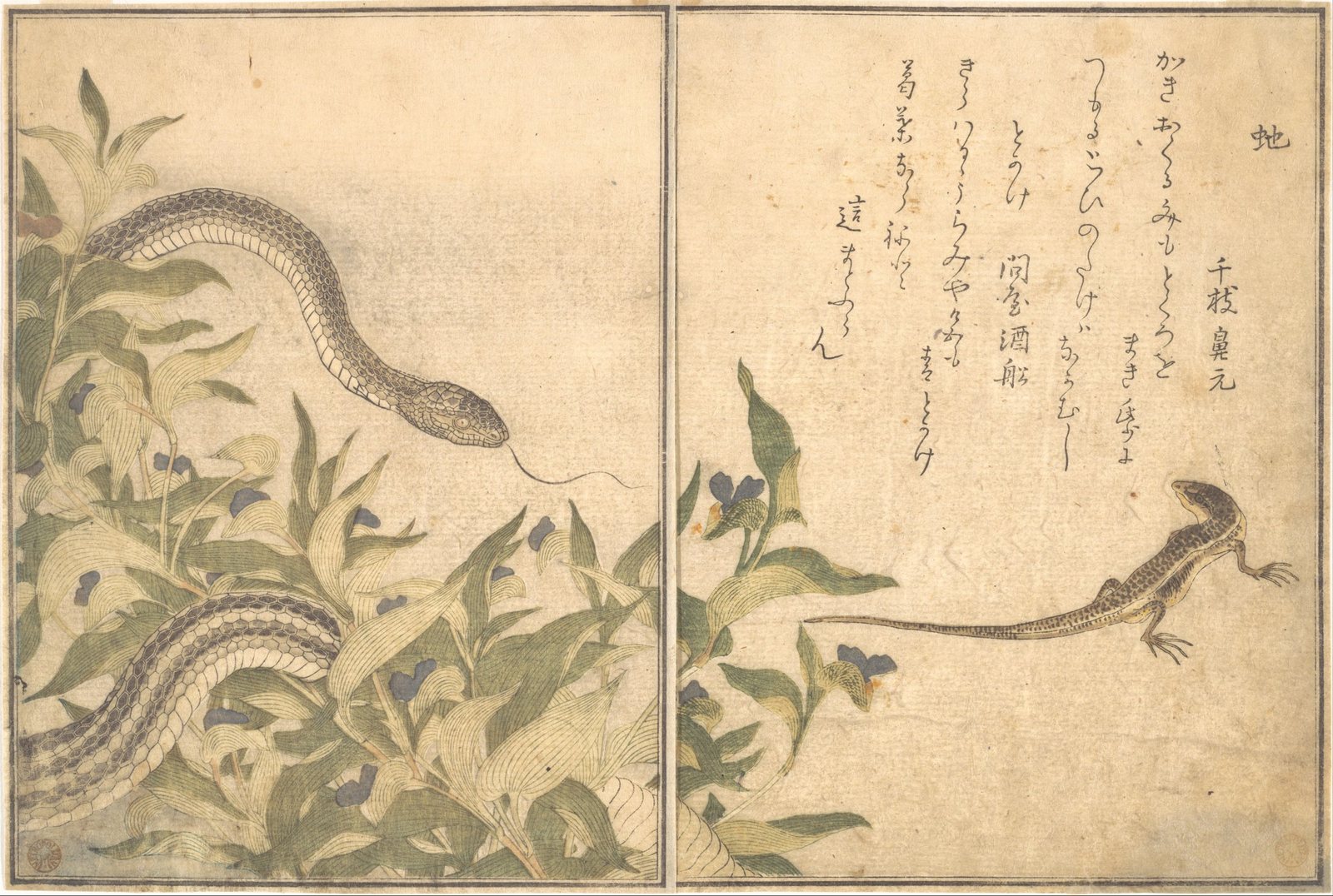
This record is the module in miniature. Its nine fields carry three kinds of information.
- Observations anyone can check: the opening number printed on the sheet, the institution that holds it, the licence.
- Conclusions reached by argument from evidence the record does not show: the designer and the date. They appear in the same typeface as the observations.
- A capture date, because everything else can change. Licences are revised, holdings move, attributions are revisited. The date says when the record was true.
Asking who made a print quickly becomes a question about records. Several databases may hold a record for your print. They use different fields, different romanisations, and different rules for who counts as the maker. To compare them, read each one on its own terms first.
The Japanese material
An Edo-period print designer worked under an art name (gō) and often changed it: to mark a new stage of work, or on taking over a teacher's studio.
The artist catalogued as Hokusai signed as Shunrō, Sōri, Taito, Iitsu and Gakyō Rōjin Manji at different times. All of these are him.
A search on one name therefore finds part of the work, and a record with a different name may still describe the same person.
The computational operation
A search treats your query literally. To a database, Hokusai, hokusai and 北斎 can be three unrelated strings.
So a search finds only what your query reaches, and the results show what matched, never what was missed.
Before opening a database, decide which question you are asking. These three sound alike.
- Who made this print?
- Returns the designer, because that is the field databases fill. The other people who made the print drop out, and the result does not say so.
- Which name does each institution give as maker?
- Returns several answers and shows where they differ. It does not show why.
- Which institutions name a maker, on what basis, and where do they disagree?
- States its evidence and what would count as no answer. A database can help with this version.
What we will do
Find records for the same print in four databases, compare what each says, and identify where they agree, where they disagree, and what each disagreement is about.
The four describe different things. A museum describes an object it owns. A national library describes a publication. An aggregator passes on whatever its contributing institutions supply. A research centre describes a specialist collection built for research. Each is accurate for its own purpose.
The Japanese material
The four used here: the Metropolitan Museum of Art (a museum record), the National Diet Library (NDL, Japan's national library), Japan Search (the national aggregator), and the Art Research Center at Ritsumeikan University (ARC, a research database of Japanese prints).
Library and museum cataloguing in Japan developed separately. A library records the publication: edition, series, extent, publisher. A museum records the object: this impression, its condition, its provenance. The same print held in both has two records, each accurate and each incomplete.
Step 1 — Read one museum record
Start with the Met, whose collection data is openly available. Find the record for your print and note three fields: the artist's name, the artist's dates, and the date of the object.
These three fields make three different kinds of claim. The name is an attribution. The artist's dates are biography. The object's date is an estimate about this print, and a ca. before it is the museum saying so.
Which field do you search on? The choice shapes everything after it.
- The artist's name as displayed
- Readable, and what you would say aloud. It varies by institution and by romanisation, so it compares poorly between databases.
- The accession or call number
- Exact and reliable within one institution, and meaningless outside it.
- An authority identifier, where one is given
- Works across institutions, and is missing from most records for Japanese material. Module 3 addresses this gap.
Step 2 — Find the same print elsewhere
Search for the print in the national library, the aggregator and the research database. Note which fields each record has, and which it leaves out. An empty field is information too: it usually reflects a cataloguing rule.
The Japanese material
A woodblock print is made by at least four people: the designer who supplies the drawing, the block cutter, the printer, and the publisher who commissions and pays for it.
Western cataloguing puts the designer in the artist field and the others in a note, or leaves them out. A library record with no creator field may be applying a rule about who is responsible for a publication, in a form where four people have a claim.
The computational operation
You can work from a copy saved on a known date, or query the institution live.
A saved copy gives a result anyone can repeat and date. A live query reflects today's record and may give a different answer tomorrow. Use a saved copy to argue about what a catalogue says; use a live query to describe current practice. Either way, record which you used and when.
Step 3 — Put the records side by side
Make one table with a row per record and these columns: source, title, maker, date, and where the date comes from. Fill in the last column only when the record states it.
The column for where the date comes from usually stays empty. Each institution gives a date; few say what it rests on.
Agreement between records is weak evidence when the records share a source. Aggregators take their fields from contributors, and contributors often copy from the same published catalogue, so four records with the same date may be one record repeated.
Disagreement is more useful. It shows that someone made a decision, and so that there is something to investigate.
Three of the four give the same date. Does that make it more likely to be right?
Show the answer
Only if the three reached it independently, and usually they did not. Trace each one back and you often reach a single printed catalogue that the others copied.
Expect this pattern: a date repeated in a dozen places, resting on one mid-century source and on nothing printed on the sheet.
A worked case: the Great Picture Book of Everything
All of this is easier to see where a record changed recently, in public, with every stage documented. The 103 Hokusai drawings the British Museum acquired in 2020 are such a case (Clark 2021).
The Japanese material
The drawings were made for an illustrated encyclopaedia, Banmotsu ehon daizen zu, which was never published. They are block-ready drawings, roughly postcard-sized, brushed on thin paper and pasted onto card, and kept in a wooden box inscribed with the title and Hokusai's name.
Block-ready drawings were normally pasted onto the woodblock and cut away in the carving, so a surviving set is rare.
Two of the sheets carry the seal of the French collector Henri Vever. The drawings were sold at auction in Paris in 1948, went into a private French collection, and do not appear in any public record for the next seventy years.
In June 2019 they reappeared at a Paris sale, catalogued as the work of Katsushika Issai, one of Hokusai's pupils. The dealer Israel Goldman bought them for €110,000, convinced they were by Hokusai himself (source to add). The British Museum's Timothy Clark agreed, and the Museum acquired them the following year.
Four questions, applied to this one group of drawings:
Where did the field come from? The maker was Issai in June 2019 and Hokusai by September 2020. One record was an auction catalogue, the other a museum acquisition. The drawings stayed the same.
Does the object carry it? In part. The box carries the title and Hokusai's name, but the box may be some seventy years younger than the drawings. Two sheets carry a collector's seal. Nothing carries a date.
Who else says it, independently? Before 2019, no record mentions the drawings. Their seventy-year absence from catalogues is a fact about the catalogues.
Has anyone disagreed? The clearest change happened within one institution. The Museum's 2020 announcement dates the drawings to 1829. Its exhibition page dates them to the 1820s–1840s, a range twenty years wider, published as research continued (sources to add).
Your dataset was built in 2020 and records the date as 1829. Is it wrong?
Show the answer
It correctly records what the source said when you captured it, and it differs from what the same source says now. Only the second is a problem, and it is easy to handle.
With a capture date, the first becomes a citation and the second a stated limitation. Without one, a later reader cannot tell whether you disagreed with the institution or simply recorded an earlier version. This is why the record at the top of this page has a captured field.
All 103 drawings are in the British Museum's online collection. They are also in Late Hokusai, a research database of the artist's late work across the British Museum, the Metropolitan Museum and the Freer|Sackler: a comparison of the kind this module teaches, built by researchers who faced the same problem.
What this cannot tell you
A comparison shows where records differ. Deciding which is correct takes evidence from outside the records.
- The date of the object. That comes from the sheet itself: a colophon, a censor's seal, a publisher's address that can be dated.
- Whether records are independent. Whether two records share a source is a bibliographic question, answered in the literature.
- What was never catalogued. Absence from four databases is a fact about those databases.
- Which names belong together. Linking 北斎, Hokusai and Hokousaï takes an authority file or your own judgement. Module 1 covers the method.
The comparison gives you a shortlist of places where the record reflects a decision. The art-historical work starts there.
Use your own materials
- Choose a print from a collection you work on and find its museum record.
- Find the same print in at least two other databases, and note the date you looked.
- Build the comparison table from step 3.
Then write four sentences: which fields differ, what each institution appears to be describing, which claim you trust least, and what evidence would settle it. The last sentence is the one to bring to a supervisor.
- Find a record in a museum collection, a library catalogue and an aggregator, and read each on its own terms.
- Say what kind of claim each field makes: observation, conclusion, or convention.
- Explain why agreement between records is weak evidence when they share a source.
- Name what a comparison of records cannot settle, and what would settle it.
Sources
- Clark, Timothy. Hokusai: The Great Picture Book of Everything. London: British Museum Press, 2021.
- The Metropolitan Museum of Art. Kitagawa Utamaro, Ehon mushi erabi, object 37292. metmuseum.org/art/collection/search/37292. Accessed 19 November 2026.